Radiator Repair and Replacement in Chattanooga
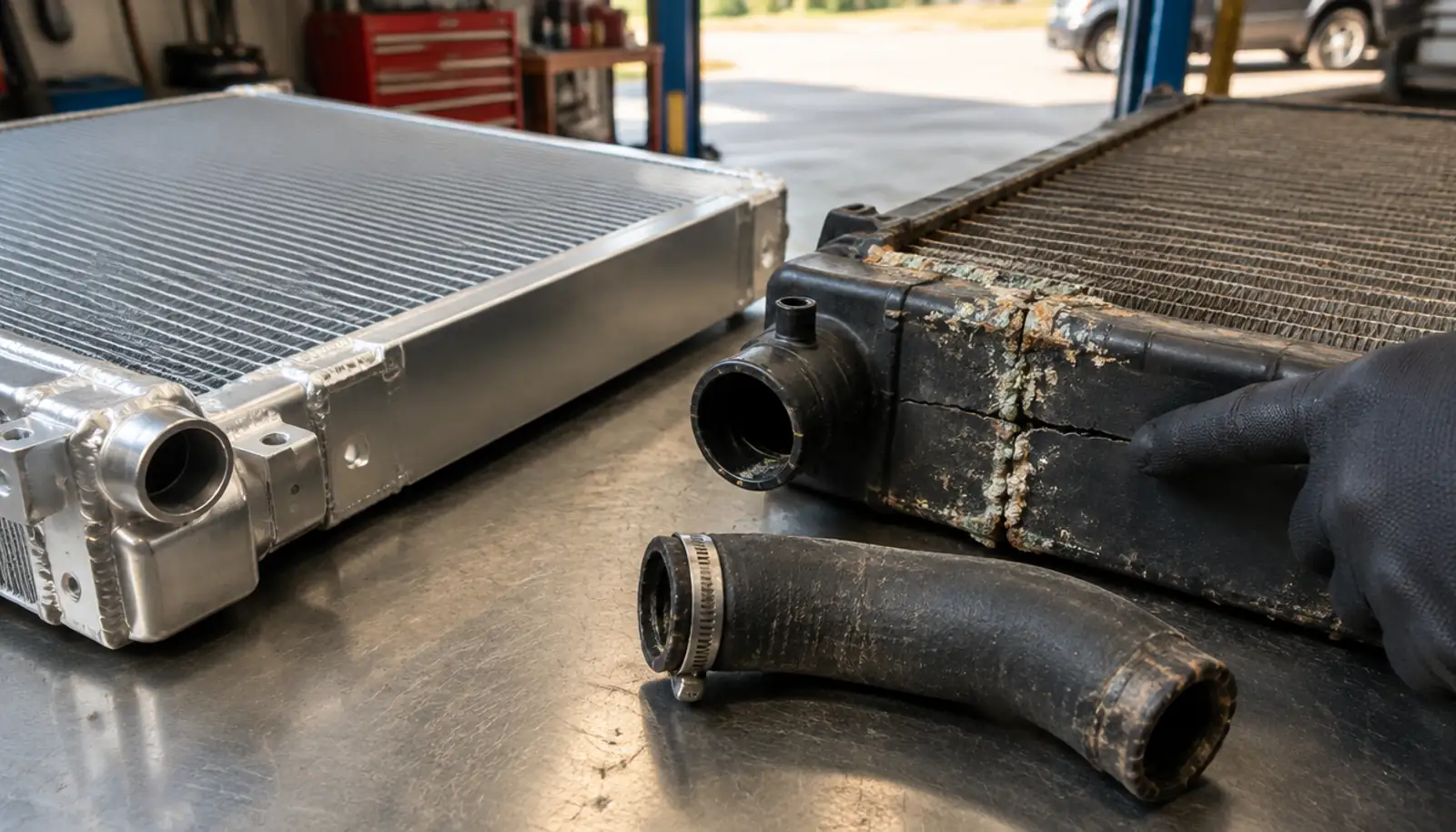
Radiators rarely fail all at once. A seam starts weeping, a plastic tank cracks along its edge, or years of tired coolant narrow the tubes until the engine runs hot on every long hill. We find out which one you've got before anyone orders a part, because a leaking hose and a leaking radiator look a lot alike from the driveway.
- ASE-certified technicians
- 12-month / 12,000-mile nationwide warranty on covered work
- CarFax Top-Rated Service Center, 6 years running
Sounds familiar?
- Coolant dripping behind the front grille, or white crust along the radiator's edges
- The gauge climbs on long hills or with the A/C on, then settles back down
- A cracked or discolored plastic tank at the top or side of the radiator
- A radiator hose that's swollen, cracked, or mushy when you squeeze it cold
- Coolant that looks rusty, sludgy, or milky
- You top up the coolant and it's low again within a week
Most radiators on the road today are an aluminum core with plastic tanks crimped onto each end. When the plastic cracks or the seam between tank and core starts to weep, a patch rarely lasts, so replacement is usually the honest fix. If the leak turns out to be a hose, a clamp, or a fitting instead, that's a smaller job, and we'll tell you so.
On many automatic transmissions, the radiator also cools the transmission fluid through a small cooler built into one of its tanks. If that cooler fails, coolant and transmission fluid mix, and a radiator problem becomes a transmission problem quickly. Milky pink transmission fluid, or coolant that looks oily or muddy, is a reason to stop driving and call.
A clogged radiator usually gives itself away on a climb: the gauge creeps up partway up Lookout Mountain or on a long pull with the A/C running, then drops back once the road levels out. That pattern usually points at the radiator, and it's worth catching before the first hot week of summer finds it for you.
Covered radiator repairs carry the 12-month, 12,000-mile warranty, and the work is logged to CarFax.
More on radiator repair and replacement
Radiator hose replacement
Radiator hoses are rubber, and rubber ages from the inside out. A hose can look fine and still be soft, swollen, or cracked where it meets the clamp. The upper hose carries the hottest coolant out of the engine and the lower one returns cooled coolant to it. They're usually the same age, so when one has worn out the other isn't far behind. We check both with the engine cold, and if they've aged together, we'll suggest replacing them together.
Radiator flush
A flush pushes the old coolant and loose deposits out of the radiator, the engine, and the heater core, then refills the system with the coolant your engine calls for. It's maintenance, done at the interval in your owner's manual, and it's one of the cheaper ways to keep a radiator alive. It won't clear a radiator that's already clogged with hard scale, though, so we look at the coolant and check the radiator first, and if a flush won't help, we'll say so before you pay for one.
Radiator Repair and Replacement questions we get a lot
Is it cheaper to repair or replace a radiator?
On most modern cars, replacing it. Aluminum and plastic radiators don't take patches well, and a repair that fails a month later costs you the job twice. Older copper and brass radiators can sometimes be repaired, and a leak in a hose or fitting is cheaper than either. We find the leak first, then give you the honest option.
What affects the cost of a radiator replacement?
The vehicle, the radiator itself, and how much has to come apart to reach it. Some radiators come out in an hour, and some sit behind the bumper and headlights. Whether the hoses, cap, or thermostat are due at the same time matters too. We give you a written quote for your car before any work starts.
Can I drive with a leaking or cracked radiator?
Not far, and not for long. A slow weep may hold for a short while if you keep the coolant topped up and watch the gauge, but a crack can split wide open under pressure without warning. Once the temperature gauge starts rising, that's your signal to stop driving it. Call us and we'll tell you whether to drive it in or have it towed.
Will a stop-leak product fix my radiator?
Sometimes, briefly, on a pinhole. It works by plugging gaps, and it can plug the small passages in the radiator and heater core along with the leak. Think of it as a way to get the car to a shop, not a repair. If you've already used some, tell us, because it changes what we look for.
How do I know if a radiator hose is bad?
With the engine cold, squeeze it. A good hose is firm and springs back. A bad one feels mushy, crunchy, or swollen, or shows cracks, bulges, or wet spots near the clamps. A hose that bursts on the highway can empty the cooling system in moments, so one that's on its way out is worth replacing before it picks the time for you.
Does a radiator flush fix overheating?
Only when old coolant or loose deposits are part of the problem. If the radiator is clogged with hard scale, the thermostat is stuck, or a fan isn't running, a flush won't change much. We find the cause first, then tell you whether a flush is the fix.
Conveniently located on Hixson Pike
We are on Hixson Pike in Chattanooga, Tennessee, easy to reach from Hixson, Red Bank, Soddy-Daisy, Signal Mountain, and the rest of the Chattanooga area. Walk in, or call to schedule a time that suits you. Mornings are usually the shortest wait.
This is a local shop in a community we live in. Whether it is the family car, a commuter, or a work truck, the location makes it an easy stop heading in or out of Hixson. Most of our customers come back because of how they were dealt with the first time, which is the only advertising that actually works.
Call (423) 556-8744Hours
- Mon - Fri8:00 AM - 5:30 PM
- Saturday8:00 AM - 3:00 PM
- SundayClosed
Hixson Pike, Chattanooga, TN

Need radiator repair and replacement in Chattanooga? Let's take a look.
Hixson Pike, Chattanooga, TN · Mon-Fri 8-5:30 | Sat 8-3 | Closed Sunday
Rather not call? Tell us what it is doing.
Describe the noise, the light, or the leak. We will get back to you with what it probably is and what it takes to find out for sure.